19 Week Four Overview
19.1 Week Four
19.2 Topics
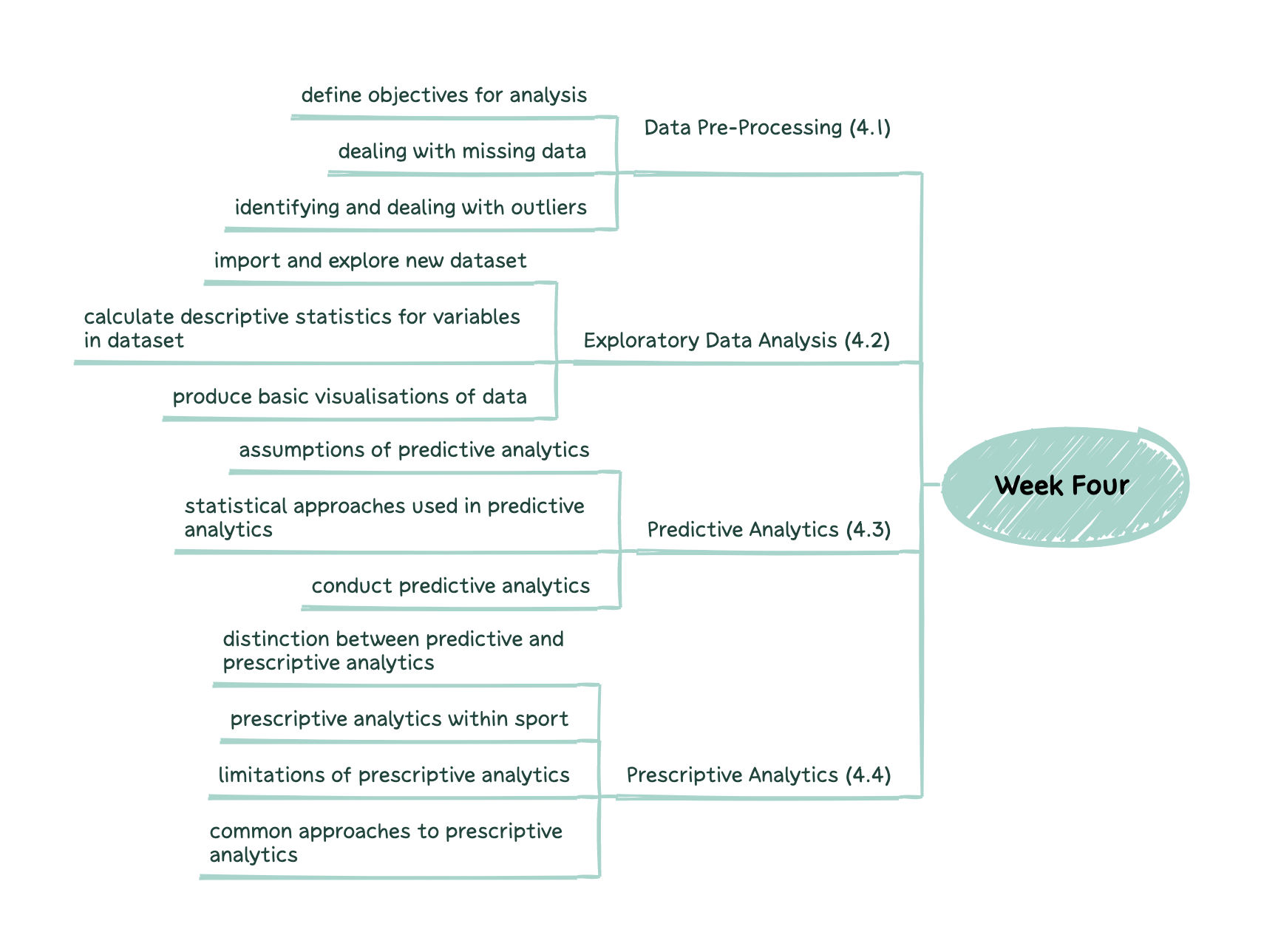
Data Pre-Processing (4.1)
understand how to define objectives for your analysis
understand how to deal with missing data
understand how to identify, and deal with, outliers in your dataset
Exploratory Data Analysis (4.2)
be able to import and explore a new dataset
understand the importance of, and how to calculate, descriptive statistics for variables within a dataset
be able to produce basic visualisations of your data
Predictive Analytics (4.3)
understand the basic assumptions of predictive analytics.
be familiar with the kinds of statistical approaches that are most commonly used in predictive analytics.
be able to conduct predictive analytics within R.
Prescriptive Analytics (4.4)
understand the distinction between predictive and prescriptive analytics
understand the role of prescriptive analytics within sport
understand the limitations of prescriptive analytics
be familiar with some some common approaches to prescriptive analytics
19.3 Reading
This week you should access and review the following papers:
Barker-Ruchti, N., R. Svensson, D. Svensson, and D. Fransson. ‘Don’t Buy a Pig in a Poke: Considering Challenges of and Problems with Performance Analysis Technologies in Swedish Men’s Elite Football.’ Performance Enhancement & Health 9, no. 1 (2021). (Barker-Ruchti et al. 2021)
Sarlis, Vangelis, and Christos Tjortjis. ‘Sports Analytics — Evaluation of Basketball Players and Team Performance’. Information Systems 93 (1 November 2020): 101562. (Sarlis and Tjortjis 2020)
Wright, Craig, Steve Atkins, and Bryan Jones. ‘An Analysis of Elite Coaches’ Engagement with Performance Analysis Services (Match, Notational Analysis and Technique Analysis)’. International Journal of Performance Analysis in Sport 12, no. 2 (1 August 2012): 436–51. (Wright, Atkins, and Jones 2012)
There are direct links to these papers via the library reading list.